Available Programs
Nido - Infants
Children’s Community - Toddlers
Children’s House - Preschool

Nido - Infants
Children’s Community - Toddlers
Children’s House - Preschool



Option 1 | Full-Day 7:00 a.m. - 6:00 p.m
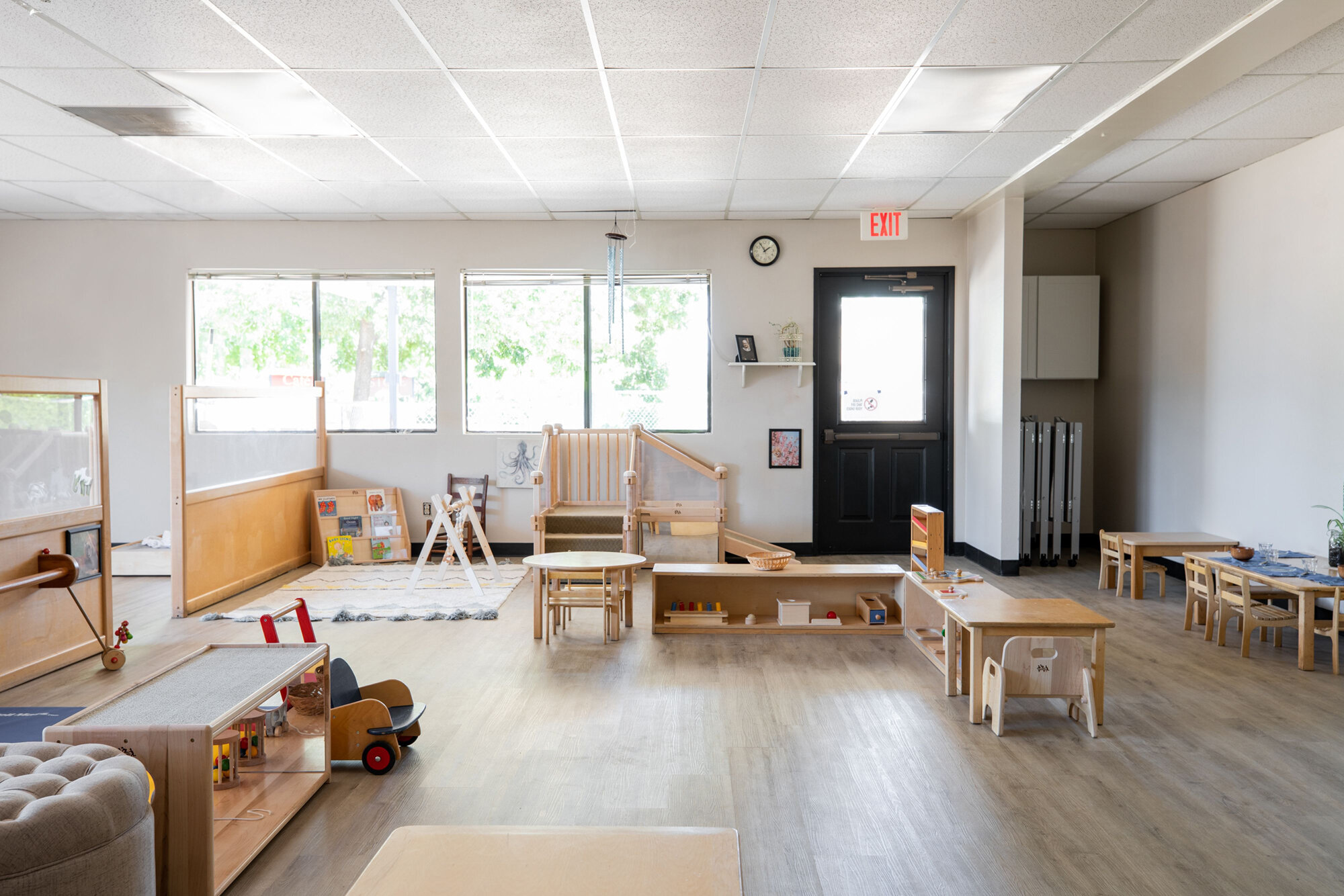
Our Infant environments, embody Maria Montessori’s vision of a “Nido” or nest. They are peaceful, loving places where babies can explore and feel secure. Teachers speak in gentle tones, the daily pace is unhurried, and décor is understated and homelike. Each child in our care is an individual to be nurtured with affection and respect. As is customary for Montessori environments, every detail is selected with the child’s whole development in mind.
Each of our infant rooms welcomes children as young as 6 weeks of age. Our prepared environments have developmentally appropriate material and activities that support the child through each stage of infant growth. Because we “follow the child,” we provide a variety of environments where infants can explore based upon her curiosity and mobility, not just her age.
The age range for our infant program is from 6 weeks to 24 months. After the age of 18 months a child may begin his transition to the toddler program. Move-up ages may vary by several months depending on the individual needs of the child.
A child’s early years are a time of great sensitivity to bonding in order to establish trust in the world; as well as language, order, sensorial impressions, and development of coordinated movement, both fine- and gross-motor. Our Infant room supports the child’s development of movement, independence, and capacity for active exploration. Because an infant’s brain is wired for language acquisition, our environments offer rich opportunities for babies to learn through plenty of reading, singing, sign language and a running dialogue as your child’s caregivers explain the events of your child’s day. Our respect for each child shows by how we engage him in each care-giving activity with warm eye-contact and verbal explanations of each step, rather than merely just doing the tasks to the child.
In our Infant environment there are special mobiles and images to stimulate brain development, as well as a variety of tactile objects for children to explore. Because this is the period when infants learn to roll over, sit, scoot, crawl and potentially walk, the room has many opportunities for movement. There are striking differences between a Montessori Infant environment and other, more traditional daycare settings: our babies do not spend their active hours in playpens, jumpers, walkers or other containers. Instead, in our Infant rooms you will see …
Many soft floor mats and bolsters on which babies can move freely and develop gross motor skills.
Mirrors positioned close to the floor to stimulate tummy time and self-discovery.
Low bars mounted to the wall and soft furniture for children to pull themselves up.
Interesting mobiles, grasping objects, and rattles within reach.
For the older infants, where crawling and newly walking babies have their hands free for exploration, you will see…
Low shelving with materials for fine-motor development and cause/effect, such as puzzles, rings on a post, and containers to open and close.
Opportunities for purposeful water play.
A stair with low steps and a railing to practice climbing up and down.
Pull and push toys to promote gross motor movement.
All of our environments have several special features that also set them apart from typical daycare settings:
We support breastfeeding! Our Infant rooms welcome mothers who would like to nurse their baby during midday visits.
We use low tables and chairs, instead of high chairs, for snacks and solid meals. We believe this provides young children with a valuable first experience at gaining independence with self-feeding.
Ours are tranquil environments where a designated nap space ensures quality rest when babies need it.
Most infants follow a routine, though not necessarily a strict schedule, that allows for feeding, active time, and nap. This routine repeats itself throughout the day and provides important predictability for young children. In our Infant environments, our Montessori guides maintain a consistent rhythm outlined by parents that responds to each child’s needs and complements what parents do at home.
Fully established Infant environments have a maximum of 12 infants and 3-4 adults, one of whom is also the Room Leader. While we strive to maintain a 4:1 ratio or less throughout the day. Once our classroom is fully enrolled, we strive to achieve at 3:1 ratio for majority of the school day. Though your child will interact with all teachers in the classroom on a daily basis, the classroom’s Head Teacher will be the main point of contact for parent communication regarding your child.
We are your partners in guiding and supporting you during the many changes in feeding routines that you will experience as your child grows.
All bottles and food for infants are supplied from home. With fridges, freezers, and warmers in our Infant environment, we are set up to safely and hygienically accommodate both breastfed and formula-fed babies, finger foods, jarred meals, homemade purees, etc.
We provide comfortable chairs for breastfeeding mothers who would like to nurse their babies on site. Parents are also welcome to drop off expressed milk anytime during the day. In our effort to encourage independence, we offer your child the opportunity and guidance to self-feed as soon as he or she is ready.
Our sleep area provide each child a dedicated floor bed in a designated, peaceful area where noise is minimized and tranquility is heightened. We work with parents to replicate techniques that work best at home for your child’s sleep patterns, while sharing tips from our experts for optimizing your child’s sleep. While pacifiers are permitted when your infant enters the school, we will gently and respectfully wean your child from these in an effort to promote oral health and self-soothing. We also help prevent tooth decay by refraining from placing bottles in cribs, or having children fall asleep while drinking a bottle. We will rock or hold a newly enrolled infant who needs such comforting to fall asleep; however, we will work with these parents to help the infants develop self-regulation in sleep habits. Our goal is for your child to recognize sleep as a peaceful opportunity to self-soothe and rest because he or she is tired, just as a child will eat when hungry. If your child arrives asleep in a car seat, he or she will be gently placed on a floor bed. Children will have the opportunity to awaken from sleep naturally, rather than being awakened by an adult.


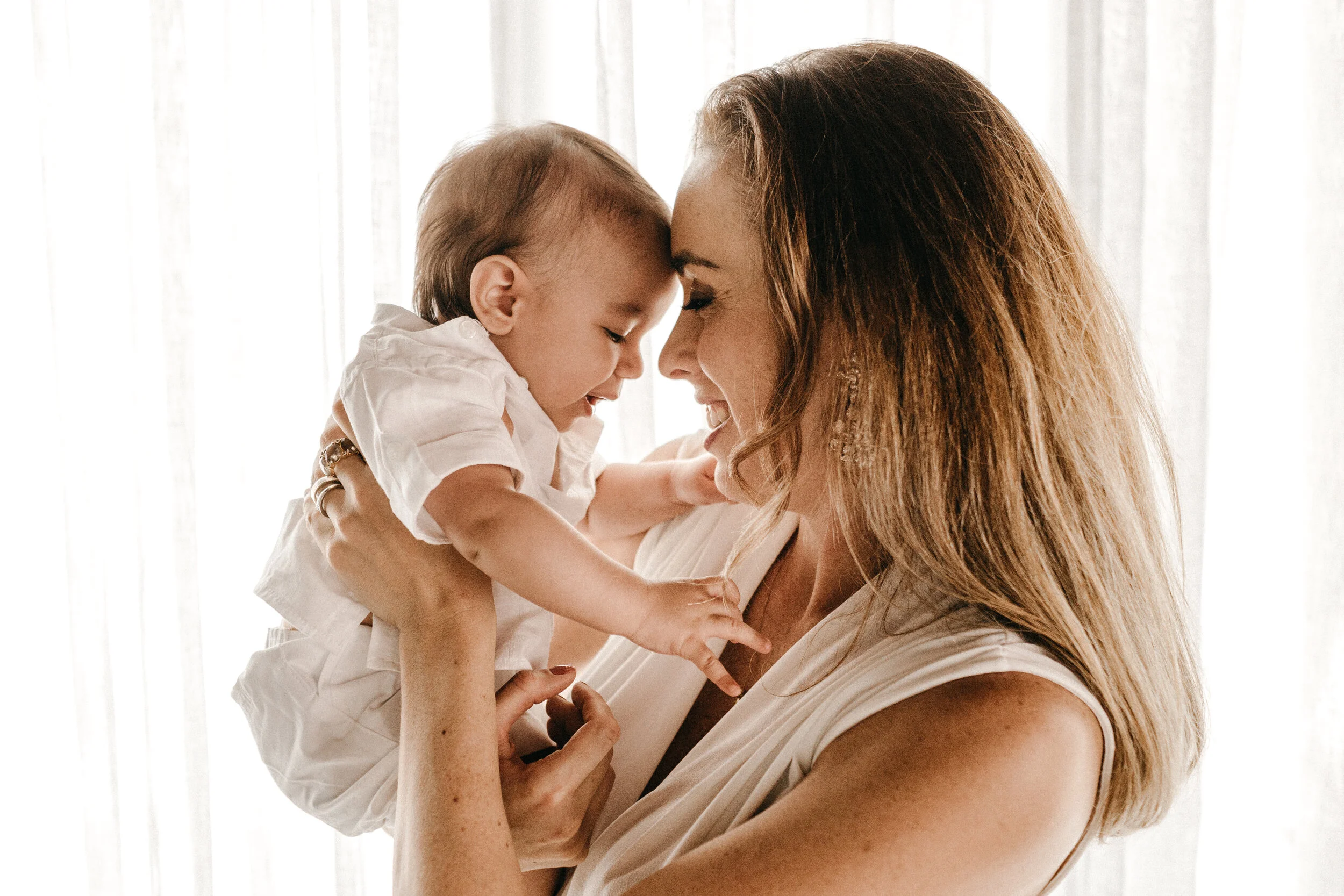
It is our priority to have close parent communication because we are all partners in caring for your child.
When your child begins in our Infant program, we will ask parents for detailed information on your baby’s sleep preferences (e.g. pacifier use), routine, feeding needs, temperament, etc. We strive to complement the home environment to ensure a sense of security and a smooth transition for your child.
On a daily basis, it is important for us to check in with parents to learn how your child slept the night before, the time of his or her last feeding, etc., so that we can best respond to his or her cues. Parents will receive the same information from us when they pick up their child at the end of each day.
We welcome parents to call and check on their children at any time, to talk informally with teachers at pick-up and drop-off time, to attend regularly scheduled parent-teacher conferences, and to book additional teacher meetings as needed.
Throughout the year, we also encourage you to attend our parent education events to learn more about child development and the Montessori approach to responding to your child’s needs. Our goal is to aid your child’s development by providing you with clear and helpful information as you journey through the infant years.
We look forward to meeting you and your infant!

Option 1 | Full-Day 7:00 a.m. - 6:00 p.m and
Option 2 | Half-Day 7:00 a.m. – 12:00 p.m.
Dr. Montessori discovered that during the toddler time, a young child has a special aptitude for learning certain things:
He is especially sensitive to order – and we build on that interest to establish good habits that last a lifetime.
He is able to absorb language from his environment – learning even big words easily and with pleasure – and becomes happier as he learns the words to express his needs, rather than needing to resort to crying or tantrums.
He is eager to learn to take care of himself, to become independent – and we guide him to learn how to do things by himself, thereby developing his budding sense of self-efficacy.
Enrolling your child in a Montessori toddler program, rather than at a childcare center, has many benefits. Here are just a few for you to consider:
A positive toilet learning experience. Done the Montessori way, almost all children can be diaper free soon after starting in our program. Sign up for our newsletter on the form at the right to discover how we work together to facilitate this developmental milestone!
Fewer toddler struggles. Montessori toddlers learn how to actually do things by themselves, making family meals more fun, and getting out of the house easier.
A child who learns to play happily by himself. Montessori toddlers learn to play independently. You may be surprised how your 2-year-old can occupy himself happily, without your constant attention, no TV baby-sitting needed!
A huge spurt in language capability. Many parents report that their children’s vocabulary increased dramatically within a few months of joining our program. Better language skills = more fun interactions with your child, and fewer tantrums caused by not being understood!
Trained Montessori teachers, many with bachelor’s degrees andAMI Montessori training who are committed to do their best work in our classrooms (not a revolving-door childcare staff).
A 1:6 , all the way to age 3 (most childcare centers switch to 1:12 at age 2).
Beautiful, welcoming facilities, professionally cleaned every day, and large, well-kept outside spaces.
Quality Montessori learning materials, not just plastic toys often found at childcare centers
A focus on helping your child develop independence skills: we are educators, not just childcare providers.
Toilet learning included at no extra charge.
Flexible schedules (half days and full days) and extended childcare available (7 am – 6 pm).
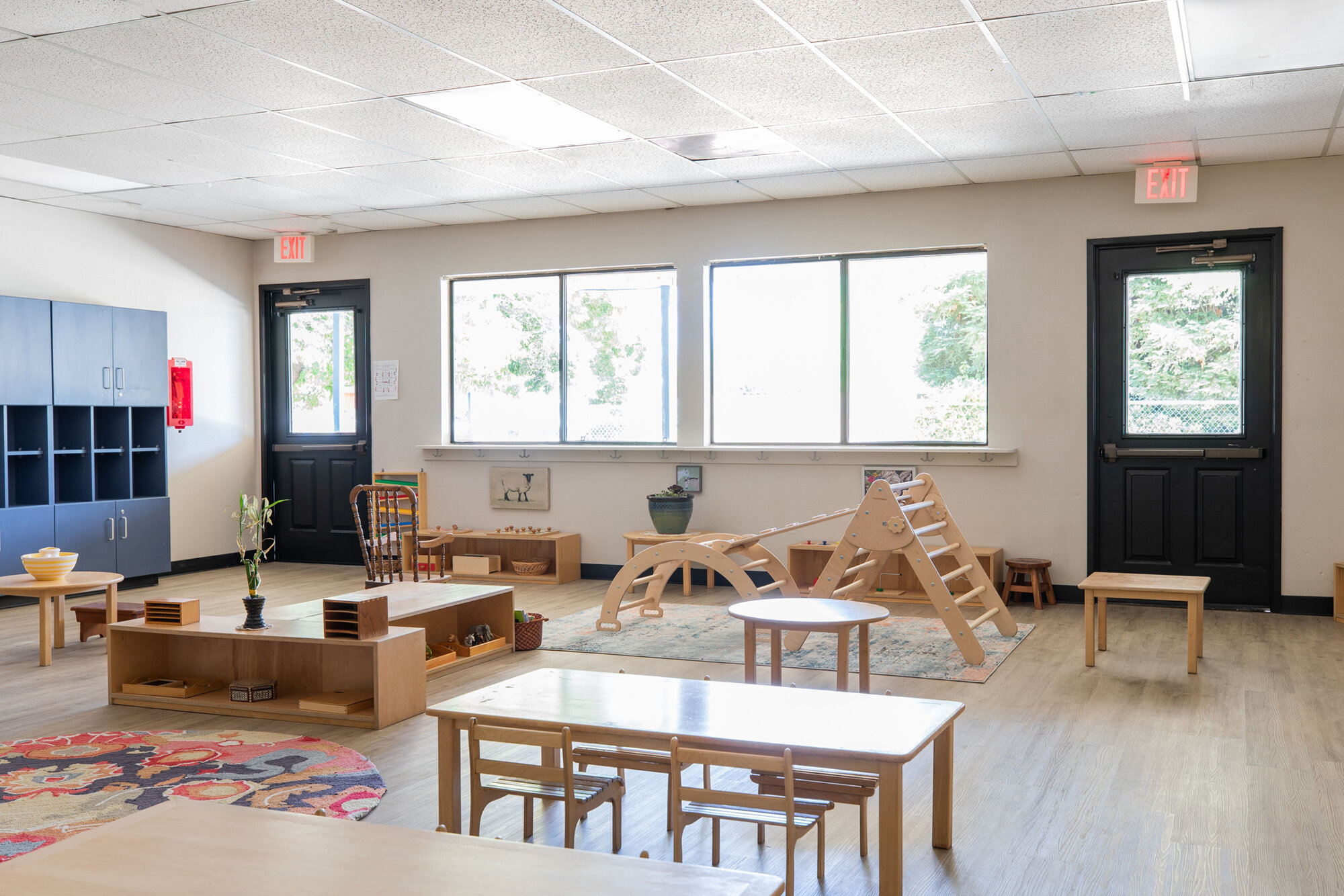
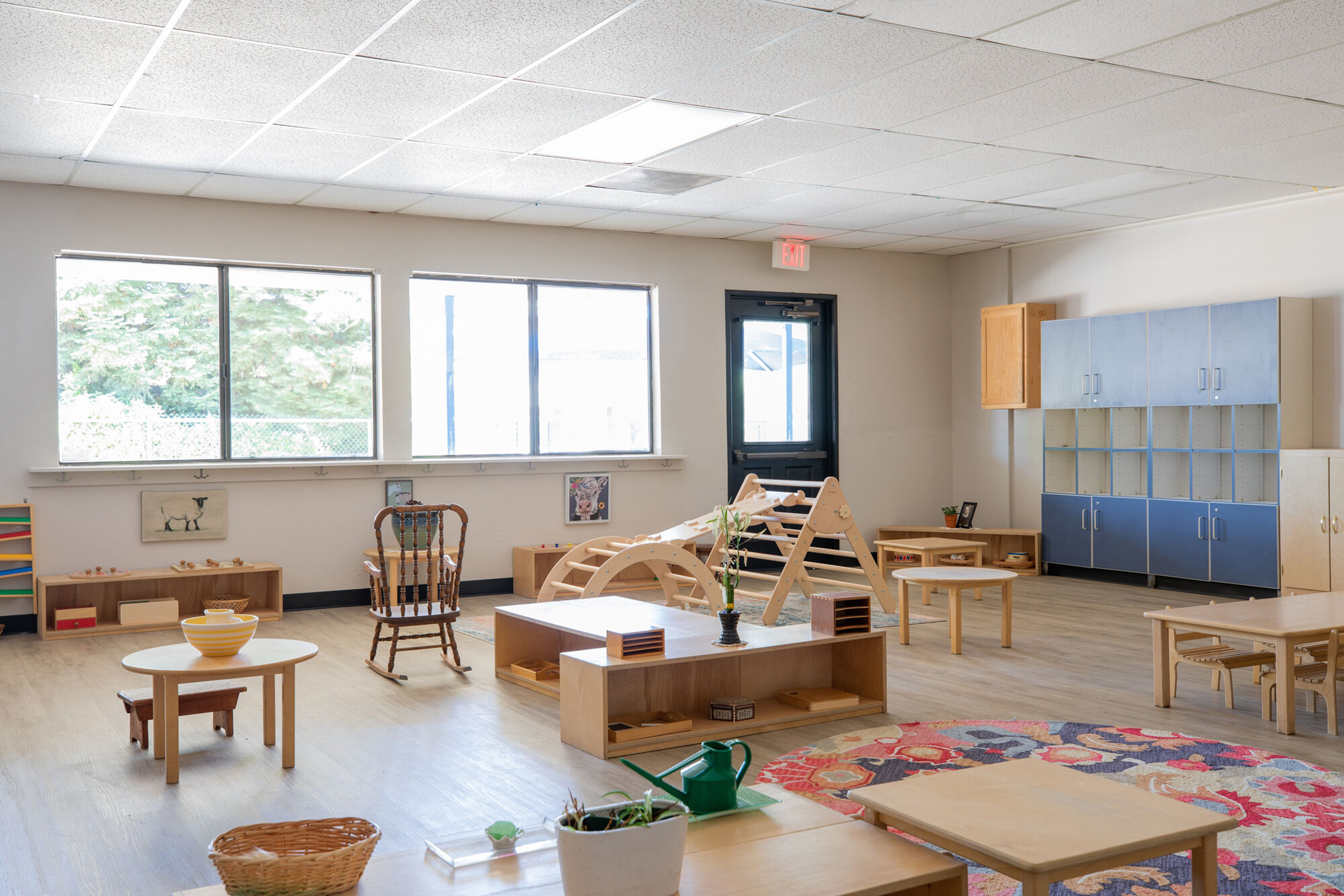
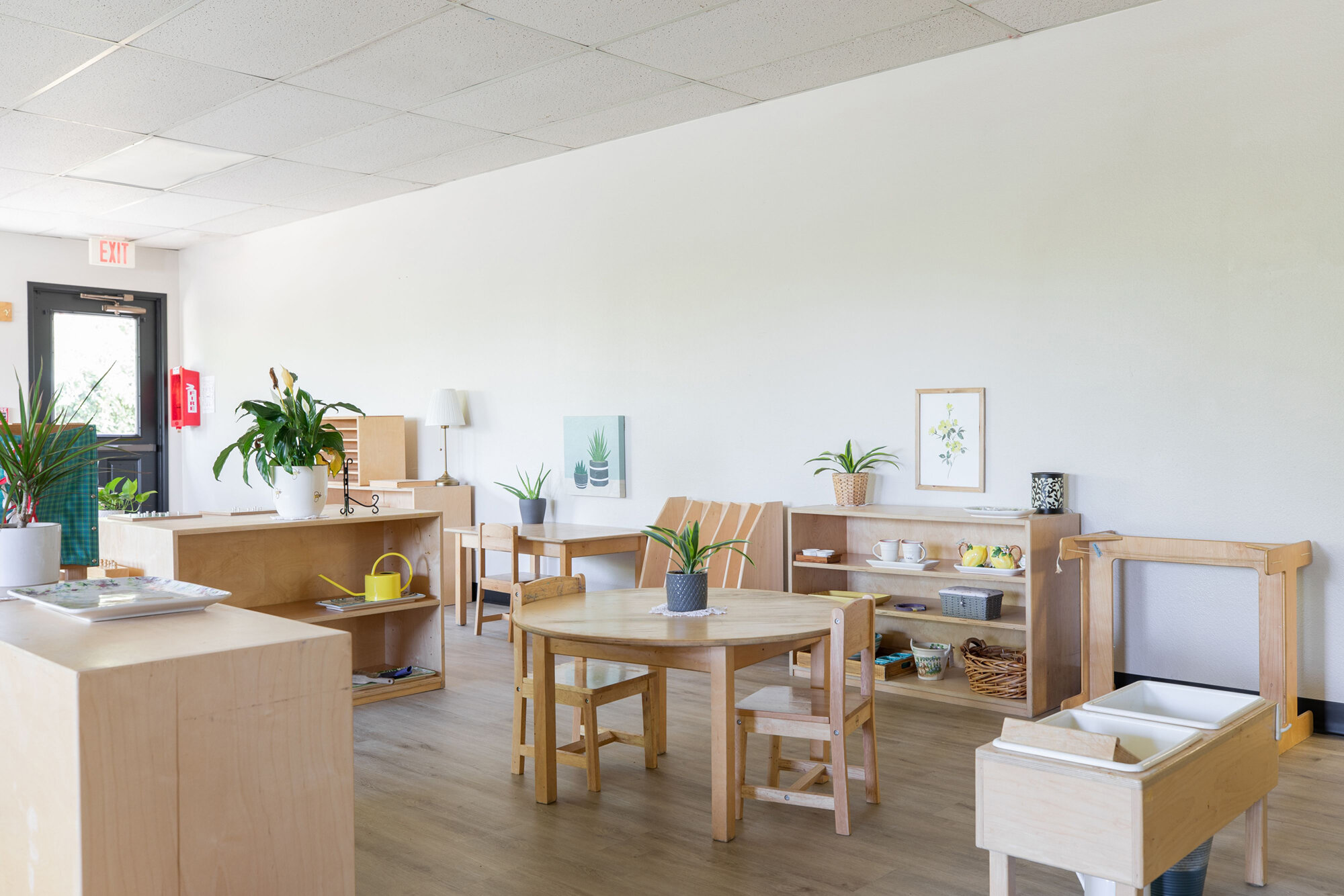
The Montessori toddler classrooms are simpler and slower paced than the Montessori preschool rooms for three to six year olds. Tables and chairs are smaller and the teacher-child ratio is lower (1:6.) The atmosphere is positive, supportive and non-competitive – and includes a lot of singing and physical movement. The toddler Montessori materials are specifically structured to meet the developmental needs of toddlers and to support their need for purposeful activity. The Montessori toddler classroom focuses on two main areas, language development and acquiring skills for independence and social interactions, supplemented by select, simplified Sensorial materials.
Toddler age children have a special sensitivity for learning language they hear spoken around them. The toddler classroom offers many creative and intriguing linguistic concepts to expand their growing vocabularies. By participating in conversations, listening to stories, classifying objects and learning songs and poems, they nurture their budding language skills.
Older toddlers even get introduced to phonetic awareness through games that ask them to isolate and repeat beginning sounds of words—an advanced skill often taught in kindergarten in other settings!
A toddler spends a large amount of time learning the self-help skills that lead to independence from constant adult help. In our classrooms, we facilitate this development in several ways.
Special “practical life” exercises break down daily tasks into manageable steps, and enable repeated practice to achieve mastery. Toddlers often are in a frustrating position: they want to do things for themselves, but do not know how. Many tantrums can be avoided by enabling a child to do things for himself at a time when he is eager to do so.
Thus, we offer our toddlers endless opportunities to practice daily tasks – from washing a table to watering plants; from dressing themselves in simple clothes (including showing them how to put on a jacket using a trick we call the “Montessori throw,” where the child positions the jacket in front of him where he can see it, puts his hands into the sleeves, then flips the jacket over his head) to mastering buttons, bows and zippers. By performing one step at a time, a child is easily able to master new skills, giving her a great sense of personal achievement and pride.
The crown jewel of the independence curriculum is our elaborate snack routine. Parents regularly comment how they are amazed that 2 ½ year olds can independently serve, jointly eat, and clean up after their daily snack.


Dr. Montessori realized that much of the toddler’s uncontrollable emotions (tantrums included) come from being out of control – and especially from being in an environment not suited to his needs. Thus, our classrooms are child-sized – and, equally importantly, orderly. A child knows, every day, what to expect when – and where to find his favorite activity. We also offer him limited choices, so he can choose without being overwhelmed.
We gently guide your child to develop the bedrock skills he needs to live together peacefully with other children and adults. We guide him to hang up his own jacket or apron, and put back a work in its proper place in the shelf. We encourage him to problem-solve rather than say “I can’t.” Because children this age have a strong tendency to imitate what they see, our teachers constantly model appropriate social skills, good manners and consideration for others. Our skilled teachers also show your child how to use words to identify the feelings they experience in themselves and that they see in others. In these ways we are able to help smooth their initial social interactions.
Our toddler program also contains a selection of psychosensorial exercises – such as bead stringing, sewing, puzzles, stacking and balancing – which help the children in developing eye-hand coordination and dexterity.
Our teachers lead the children in song, dance and a variety of other exercises that offer them the opportunity to jump, climb, balance, crawl or skip. These exercise their large muscles and support the development of balance and equilibrium.


Childcare centers often have high staff turnover: low-paid, poorly trained childcare providers rarely view their job as a career. This is not the case with Rocklin Ranch Montessori: we recruit, train and retain highly trained Montessori teachers. Each of our head toddler teachers has either already completed the intensive, AMI Assistant to Infancy training or we train her in-house, as an assistant teacher, and then sponsor her for the full Montessori training while she works for us. At Rocklin Ranch, teaching toddlers is a career, not a passing childcare job.
A well-trained, well-compensated, steady staff is essential at Rocklin Ranch and we do not just want your child to be in a safe, fun childcare setting; we want him to learn and grow by leaps and bounds!
Option 1 | Half-Day 7:00 a.m. - 12:00 p.m and
Option 2 | Full-Day 7:00 a.m. – 6:00 p.m. (children arrive by 8:30am and you pick your pick up time)
Maria Montessori, the first female physician in Italy, invented the Montessori approach to education. The Montessori method concentrates on the specific developmental needs of the child. Montessori believed that everyone learns differently, and at his or her own pace. She created a new type of classroom, a prepared environment, to accommodate and stimulate the individual interests of her students. The role of the directress becomes to follow the development of the child, on a one-to-one basis.
Independence. The Montessori method has been in existence for more than one hundred years. If there is one trait that exemplifies the success of a Montessori school, it is that their students are creative, responsible and highly independent. If independence is coveted above all else, it is because it creates the freedom that is needed to develop, both academically and socially. Montessori helps children to think and act for themselves, independently and with the courage of thought.
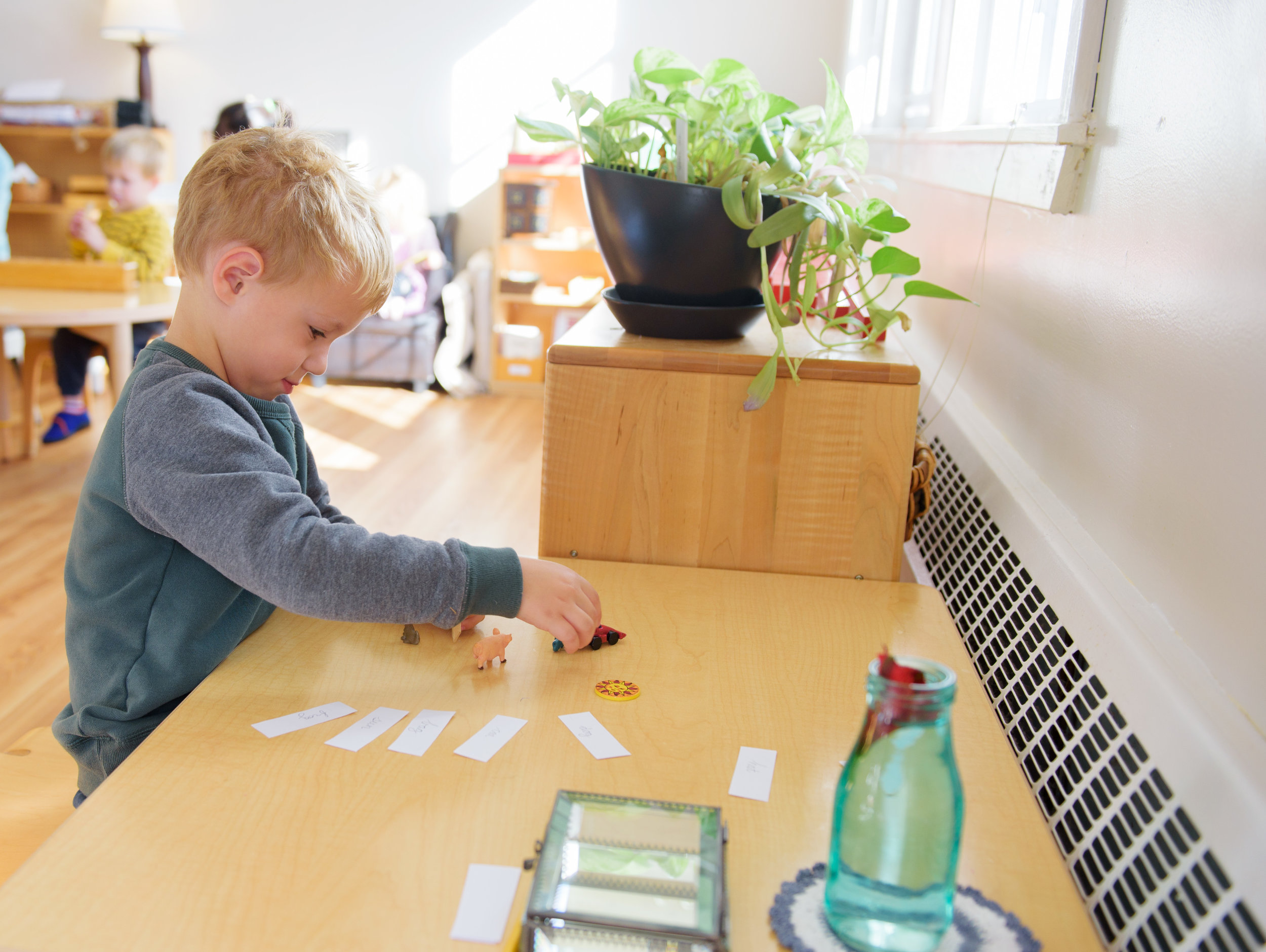
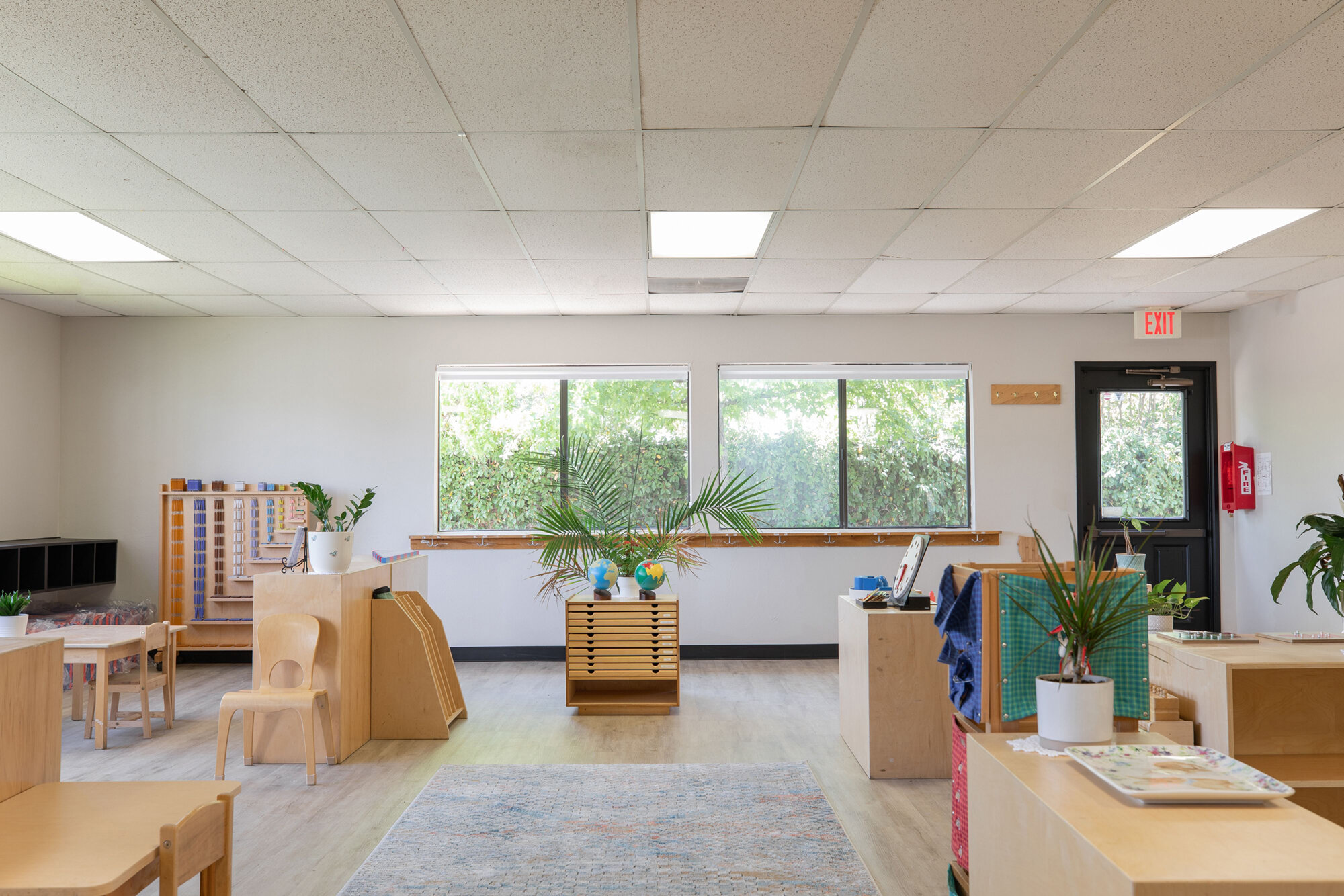
At Rocklin Ranch Montessori each child is encouraged to develop at their own pace in a specially designed learning environment. The materials are carefully prepared and displayed for the children. Children are thereby free to choose their own activities. Each activity that is undertaken is complete in itself and relates to the other activities that cover physical, social and intellectual aspects of the development of the child. Children often concentrate for long periods of time, working individually or spontaneously with a group of friends.
The materials in an authentic Montessori classroom are specifically designed and engineered to increase and enhance your child. “The fundamental fact in the preparation of the environment is to have only one set of each type of material. When there is only one specimen of each object, and if apiece is in use when another child wants it, the latter will wait for it to be released. Since this happens every hour of the day for years, the idea of respecting others, and of waiting one’s turn, becomes a habitual part of life which always grows more mature.”
Maria Montessori states it best when she writes, “We must support as much as possible the child's desires for activity; not wait on him, but educate him to be independent. It is necessary for the teacher to guide the child without letting him feel her presence too much, so that she may always be ready to supply the desired help, but may never be the obstacle between the child and his experience.” Alongside these principles, Montessorians believe in a mixed age classroom.

· Emphasis placed on cognition.
· Emphasis placed on social formation.
· Teacher as guide of classroom.
· Environment and method promote self-discipline.
· Primarily individual instruction.
· Teacher encourages collaboration.
· Mixed age children.
· Child chooses their own work.
· Self-teaching materials help child learn concepts.
· Child is allocated time to complete lessons.
· Learning pace set by individual student.
· Child discovers errors.
· Internal reinforcement of learning success.
· Personal feelings of progress.
· Child is free to work in the classroom.
· Group participation elective.
· Self care learned.
· Emphasis placed on rote learning.
· Emphasis placed on rote social behavior
· Teacher controls the classroom.
· Teacher is only disciplinarian in the classroom.
· Teaching dictated by teacher.
· Same age children.
· Teacher assigns work.
· Teacher instructs child on concepts.
· Limited time allotted on projects.
· Learning pace set by group.
· Teacher highlights the errors the child makes.
· External reinforcement of learning success.
· Rewards and punishments.
· Normally assigned a specific location in class.
· Group participation is required.
· Self care left to parents.
In the Practical Life area, children work with familiar household activities that they see in everyday life, such as washing, sweeping, etc. By working in this area, children are not only gaining their essential life skills but they are also developing eye-hand coordination and the ability to concentrate for long periods of time, covering the duration of an activity. As a result of their own achievements, they build self-confidence.
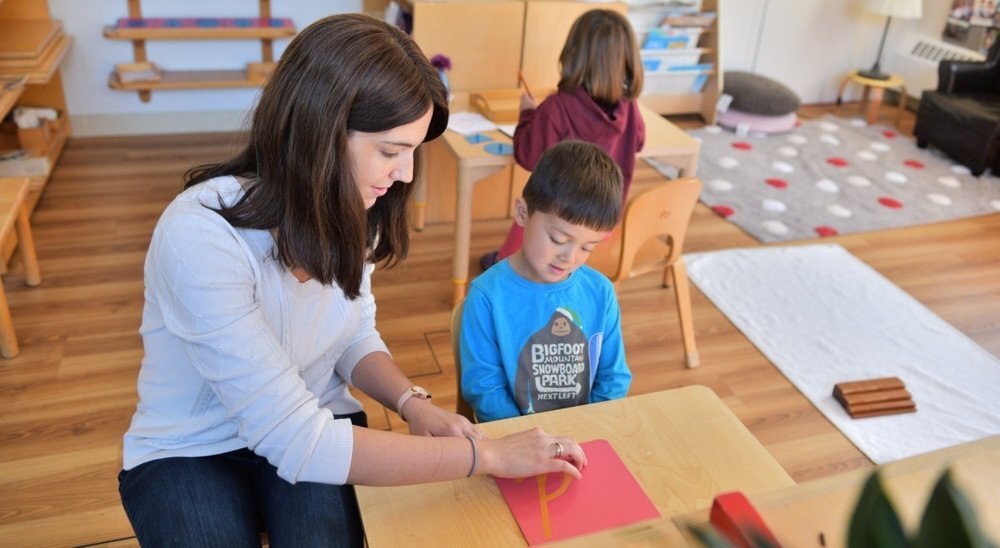
Social skills are developed in conjunction with a vocabulary that is based on real experience. These tasks help prepare the children for reading and writing but also look beyond such basic skills into the pleasures of reading and writing, and the imagination and creation that is involved.
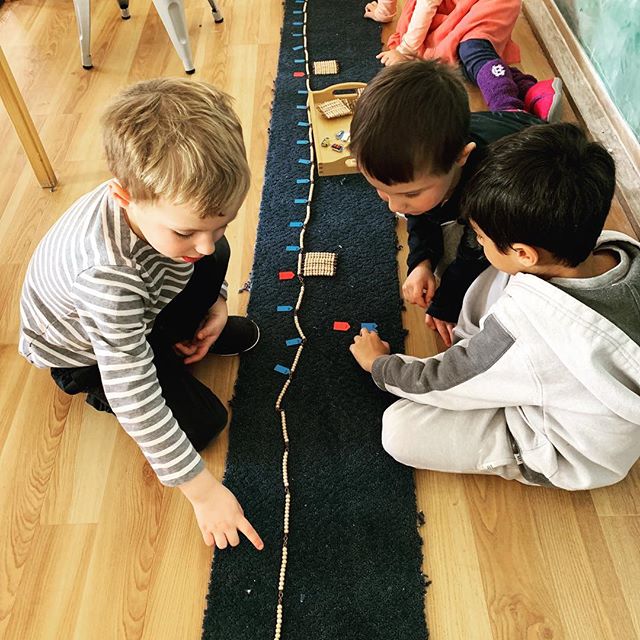
In the Children’s House, mathematical concepts are introduced to the children in a concrete form. By working with these materials, children slowly grasp concrete ideas and gradually form abstract concepts. This work provides them with a solid foundation for elemental mathematical principles used later in arithmetic work.


Children are keen observers, and as a result, extremely aware of the world. Through their senses, they are constantly exploring their environment. The sensorial materials challenge the children on a number of levels, most importantly, they encourage the children to engage with the elements of the world. These selected activities nourish and develop the senses, especially communication, observation and exploration.
One of the fundamental tenets to Montessori education is culture. Montessori students are well rounded because Montessori strives, above all else, to connect the child to the concrete, material world. Through various activities and materials, Montessori exposes children to the joys of culture. We constantly strive to expose our students to a wide range of cultural activities, which include music, art, geography.